

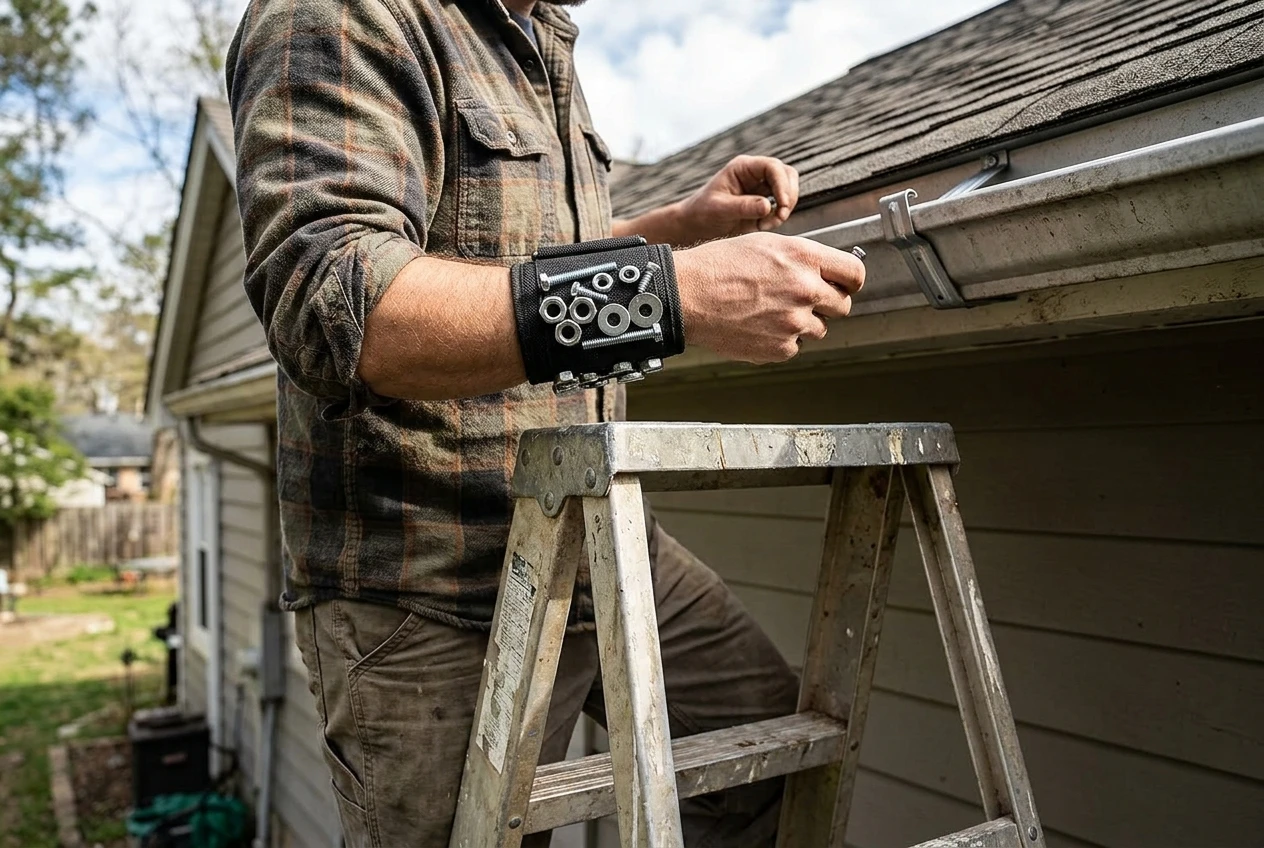
A magnetic wristband is a cuff or strap, usually fabric or neoprene, with small magnets sewn or glued into the fabric in a row. You wrap it around your wrist, press screws or nails or drill bits against it, and the fasteners stay put while your hands do something else. The pitch is simple: no more screws in your mouth, no more fishing a dropped nail out of carpet. The question worth answering before you buy one is whether it actually saves time on the jobs you do, or whether it just sits in a drawer after the novelty wears off.
A magnetic wristband for screws can keep a few small steel fasteners within reach during quick fixes, but it won’t replace a parts tray or tool belt on every job.
This isn’t a tool that helps with everything. It helps with a specific kind of job: short fasteners, repetitive placement, and situations where your hands are already full of something else. Outside that narrow lane, it does very little. Here’s where the line actually falls.
Quick Answer
Do magnetic wristbands speed up small repairs?
They can, especially on short jobs that use several small steel fasteners. The main benefit is keeping screws close while your hands are busy. They are less useful for long or heavy screws, large bits, and metals that do not stick well to magnets.
What A Magnetic Wristband Actually Holds (And What Slips Right Off)
The magnets in most wristbands are small and arranged to grip by contact, not by deep penetrating pull. That means they’re built for things with a flat head and a reasonable amount of steel in contact with the band: drywall screws, deck screws, finish nails, small hex bits, washers.
What slips off: anything heavy enough that gravity wins the argument with the magnet, and anything made from a non-magnetic metal. Stainless steel fasteners vary a lot in how magnetic they are depending on the alloy, so a bag of stainless deck screws might barely stick at all even though a box-store drywall screw grips fine. Brass screws, aluminum nails, and most washers used in plumbing won’t hold either.
Long screws are also a problem, not because the magnet can’t hold them, but because they hang off the band at an angle and catch on your sleeve, your tool belt, or the doorframe when you reach past it. A two-inch screw rides fine. A four-inch lag bolt turns into a pendulum.
The Five-Minute Jobs Where It Earns Its Keep
This is where the wristband actually changes how a job feels, not just how it looks.
Swapping an outlet or switch plate: you’re holding the cover plate, maybe the device itself, and you need both hands to position the screw and drive it with a screwdriver. Setting the screw down on a step stool or a nearby surface means it rolls off. Keeping it in your mouth is fine until you need to talk to someone or you’re working above shoulder height. A wristband holds the one or two screws you need for that plate right at your wrist, and you pick them off one at a time without looking away from the work.
Replacing hinges on a cabinet door or interior door: hinge screws are small, there are usually four to six of them per hinge, and you’re often holding the door or the hinge leaf in position with one hand while trying to start a screw with the other. A dropped hinge screw on a hardwood floor goes skittering. Having the full set on your wrist means you’re not stopping to hunt one down mid-job.
Hanging a shelf with a bracket: same logic. You’re holding the bracket against the wall, checking it’s level, and reaching for a screw without being able to glance down at a pile on the counter. The wristband puts the fastener where your hand already is.
In all three of these, the time saved isn’t dramatic on any single screw. It’s the accumulation across a job with six, eight, twelve fasteners, and it’s the avoided time of chasing one that rolled under the fridge.
Up A Ladder With No Pockets: Why Hands-Free Access Matters Most There
This is the single biggest case for owning one. On a ladder, you don’t have a flat surface to set anything on, and digging into a pocket means letting go of the ladder or the work with one hand while you’re already balanced awkwardly. A dropped screw from eight feet up isn’t just inconvenient, it means climbing down, finding it, and climbing back up, which is where most of the real time loss on a ladder job actually happens.
Gutter guard clips, fascia screws, exterior light fixture screws, anything mounted overhead where you need a free hand to hold the fixture steady while the other drives the fastener: this is the job type where the wristband stops being a convenience and starts being the difference between one trip up the ladder and three. If you only use it for one category of task, this is the one to test first.
Where It Falls Short: Long Screws, Big Bits, And Metal Fatigue On Your Wrist
Deck building and larger framing work expose the limits fast. Deck screws in the three-inch range are common for ledger boards and joist work, and at that length the magnet is holding one end of a fastener that wants to swing the other way every time you move your arm. You end up steadying it with your other hand anyway, which defeats the purpose.
Large drill bits and driver bits have the same problem from the other direction: they’re often short and heavy relative to their magnetic surface area, and a half-inch spade bit just doesn’t sit well on a band designed for screws.
There’s also a comfort issue on longer jobs. A band with a lot of magnets sewn close together gets stiff, and if you’re wearing it for hours of repetitive wrist motion, that stiffness shows up as mild fatigue by the end of the day. It’s not a reason to avoid the tool, but it’s a reason not to expect it to replace a proper tool belt or apron for anything beyond an afternoon of small repairs.
Strength, Comfort, And The Difference A Weak Magnet Makes Mid-Project
Not all magnetic wristbands are built the same, and the gap between a well-made one and a cheap one shows up exactly when you need it most. A weak magnet holds a screw while your arm is still, then drops it the moment you twist your wrist to reach for the drill. That’s worse than not having one at all, because now you’re bending down to pick up a dropped screw in the middle of a task you expected to be hands-free.
Look for a band where the magnets sit flush with the fabric rather than recessed, and where the strap itself is adjustable enough to sit snug against your wrist without sliding down over your hand. A band that shifts position while you work means you’re constantly readjusting it instead of just reaching for a screw.
Which Jobs Suit a Magnetic Wristband?
A quick comparison based on the fasteners and situations described in this post.
| Job | Fit | Why |
|---|---|---|
| Outlet or switch plate | Good fit | Keeps the small screws close while you position the plate. |
| Cabinet or door hinges | Good fit | Helps keep several small screws within reach while you hold the hinge or door. |
| Shelf bracket | Good fit | Keeps a fastener close while your other hand holds or levels the bracket. |
| Gutter guard or exterior fixture on a ladder | Strong fit | There may be no nearby surface for screws, and dropped fasteners can mean another trip down. |
| Deck building or framing | Limited | Longer, heavier screws can swing, catch, or need steadying by hand. |
| Large drill or driver bits | Limited | Large or heavy bits may not sit securely on a band made for smaller fasteners. |
Is It Worth Adding To Your Toolbox, Or Just A Drawer Novelty
For outlet swaps, hinge work, shelf hanging, and anything on a ladder, a magnetic wristband genuinely saves time and aggravation, mostly by preventing the small stoppages that come from a dropped or misplaced fastener. For deck building, framing, or anything involving long screws and heavy bits, it doesn’t do much and can get in the way.
The honest answer is that it earns its spot for a specific slice of jobs and sits unused for the rest. Whether that’s worth the drawer space depends on how often your weekend list looks like the first category rather than the second.
If you’ve got a small repair on this weekend’s list, test a magnetic wristband on that one job before deciding whether it earns a permanent spot in your toolbox.
Magnetic Wristband FAQs
Will a magnetic wristband hold every screw?
No. It works best with small steel fasteners that make good contact with the magnets. Brass, aluminum, and some stainless steel fasteners may not stick well.
Are magnetic wristbands useful for long screws?
They can be awkward with long screws. A long fastener may hang at an angle, swing as you move, or catch on clothing and nearby objects.
What jobs are magnetic wristbands best for?
They are most useful for short repairs with several small fasteners, such as hinge work, shelf brackets, and some jobs where you are working on a ladder.
Do stainless steel screws stick to magnets?
It depends on the alloy. Some stainless steel fasteners are more magnetic than others, so test a screw before relying on the wristband.
Can a magnetic wristband replace a tool belt?
No. It is best for keeping a few small fasteners close during short repairs. It is not a replacement for a tool belt or apron on longer jobs.